Why the inside matters more than the fabric
Two navy suits can look identical on the rack, yet after three years one still holds its shape while the other bubbles at the chest. The difference is rarely the cloth — it is the interlining construction. A suit front is not a single layer: fabric, chest canvas and lining are built up together, and how that structure is made determines the smoothness of the line, the feel on the body, the garment's lifespan and its price. The trade knows three methods: fused, half canvas and full canvas.
Fused: heat-pressed glue, the lowest cost
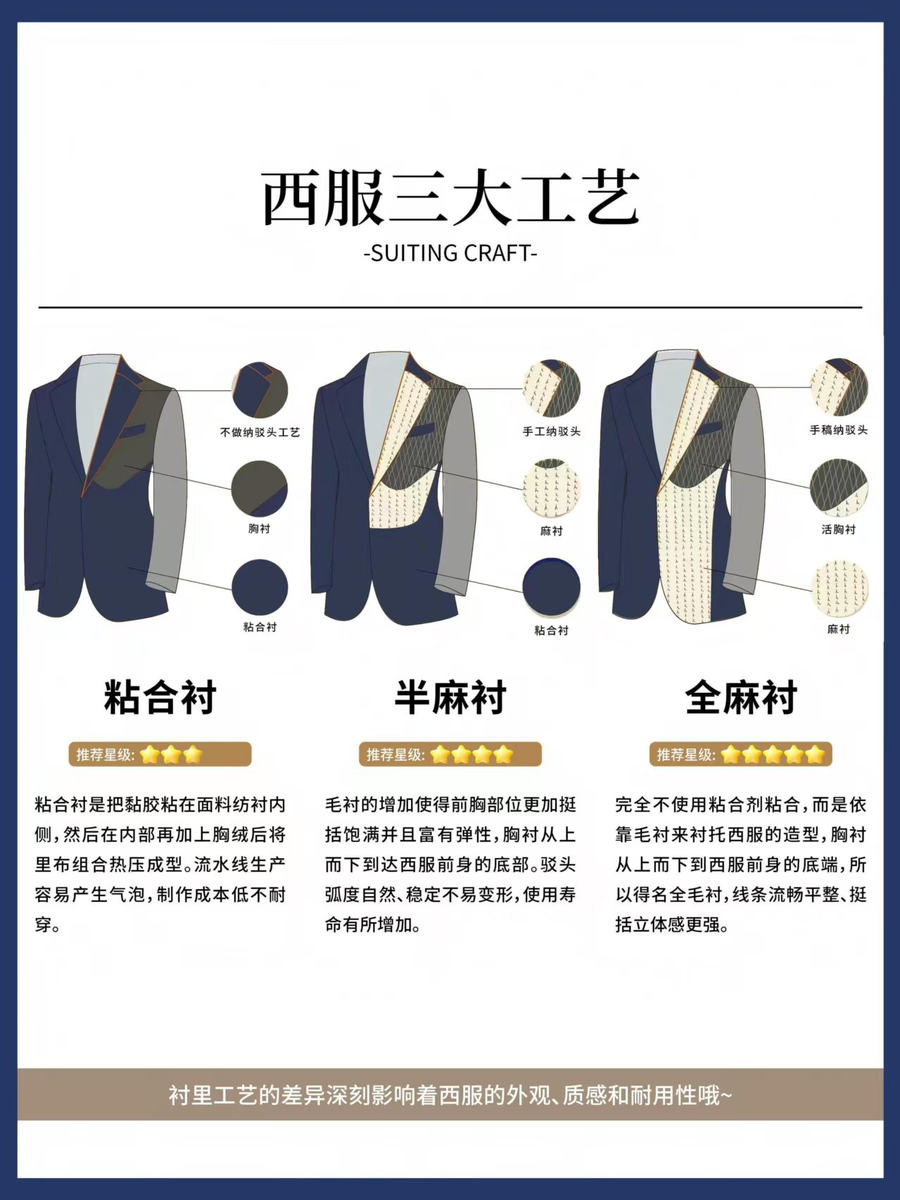
Adhesive is applied to the inside of the face fabric, a layer of chest wadding is added, and the lining is bonded under heat and pressure. The whole front is held together by glue — no hand-padding of the lapel is needed — which makes it ideal for high-volume production and keeps costs low.
The trade-off is equally clear: moisture, dry cleaning and hot pressing can cause the glue to bubble or delaminate, the chest gradually stiffens, and the lapel cannot develop a natural roll. This is the construction behind most low-priced off-the-rack suits and the main reason a jacket can lose its shape after a single season. If your budget allows, it is not recommended for a bespoke commission.
Half canvas: a floating chest piece and a hand-padded lapel
Half canvas starts with a fused lower front but adds a layer of horsehair canvas across the chest, secured stitch by stitch with a hand-padded lapel. The chest piece extends from the top down to the middle of the front (around the waist), while the lower section remains fused.
That extra canvas makes the chest fuller, more resilient and more elastic; the lapel rolls naturally, holds its shape and resists distortion, and the garment lasts considerably longer than a fused one. It is the most practical balance of cost and result — a strong choice for daily office wear, a first bespoke suit or a fixed budget.
Full canvas: no glue at all, shaped entirely by the canvas
Full canvas uses no adhesive whatsoever. The horsehair canvas itself shapes the jacket, running from the top all the way to the bottom of the front, paired with a floating chest piece and a hand-padded lapel — hence the name "full".
Because the entire front is a flexible structure that moves slightly with the body, the lines are the cleanest and flattest, with the strongest three-dimensional shape. It actually moulds to the wearer over time and cannot bubble. The cost is more operations, more hand work, greater dependence on precise measuring, and a higher price. For a wedding, an important business occasion, or a suit intended to last a decade or more, it is worth it.
Three checks when you commission a suit
1. Roll the lapel. Gently rub the underside between finger and thumb. Fine, dense stitches and a layer that shifts slightly indicate a hand-padded canvas; a uniformly stiff, featureless panel usually means fused.
2. Pinch the chest. A fused front feels hard and board-like; half and full canvas feel supple and spring back when released.
3. Ask directly: which construction is used, does the canvas reach the hem or only the waist, is the lapel hand-padded? A reputable tailor will state it on the specification sheet or answer plainly. Silence usually means the most basic option.
The difference in interlining construction profoundly affects a suit's appearance, texture and durability. Asking this one question before you order helps ensure you are not paying bespoke prices for a production-line method.
At a glance
Fused: heat-pressed · no padded lapel · prone to bubbling · cheap, short-lived
Half canvas: chest canvas + hand-padded lapel · canvas to the waist · structured, resilient, shape-stable · best value
Full canvas: no adhesive + floating chest piece + hand-padded lapel · canvas to the hem · cleanest drape, longest life · highest price
Explore Bespoke ServicesFrequently Asked Questions
What is the difference between fused, half-canvas and full-canvas suits?
A fused suit glues the interlining to the fabric under heat and pressure: cheap to make, but prone to bubbling and short-lived. A half-canvas suit adds a floating chest canvas with a hand-padded lapel down to the waist, giving a fuller, more resilient chest. A full-canvas suit uses no adhesive at all: the canvas shapes the entire front down to the hem, producing the cleanest lines and the strongest three-dimensional drape.
How can I tell which construction a bespoke suit uses?
Three checks: gently roll the lapel — fine hand stitches and a layer that moves slightly indicate a hand-padded canvas; pinch the chest — fused fronts feel stiff and board-like, while canvas fronts are supple and spring back; and simply ask the fitter which construction is used and whether the canvas reaches the hem or only the waist. A reputable tailor will answer clearly.
Should I choose half canvas or full canvas?
Half canvas offers the best value for a first bespoke suit, daily office wear or a limited budget. Choose full canvas for weddings, important business occasions, a garment intended to last a decade or more, and the most natural lapel roll and three-dimensional shape. Both outlast a fused construction.